
Ivy Endodontics at Princeton · Advanced Procedures
Apicoectomy
Plainsboro, NJ
When a tooth doesn't heal fully after a root canal, an apicoectomy can eliminate the remaining infection and save your natural tooth without having to start over.

Preserve Your Tooth. Protect Your Health.
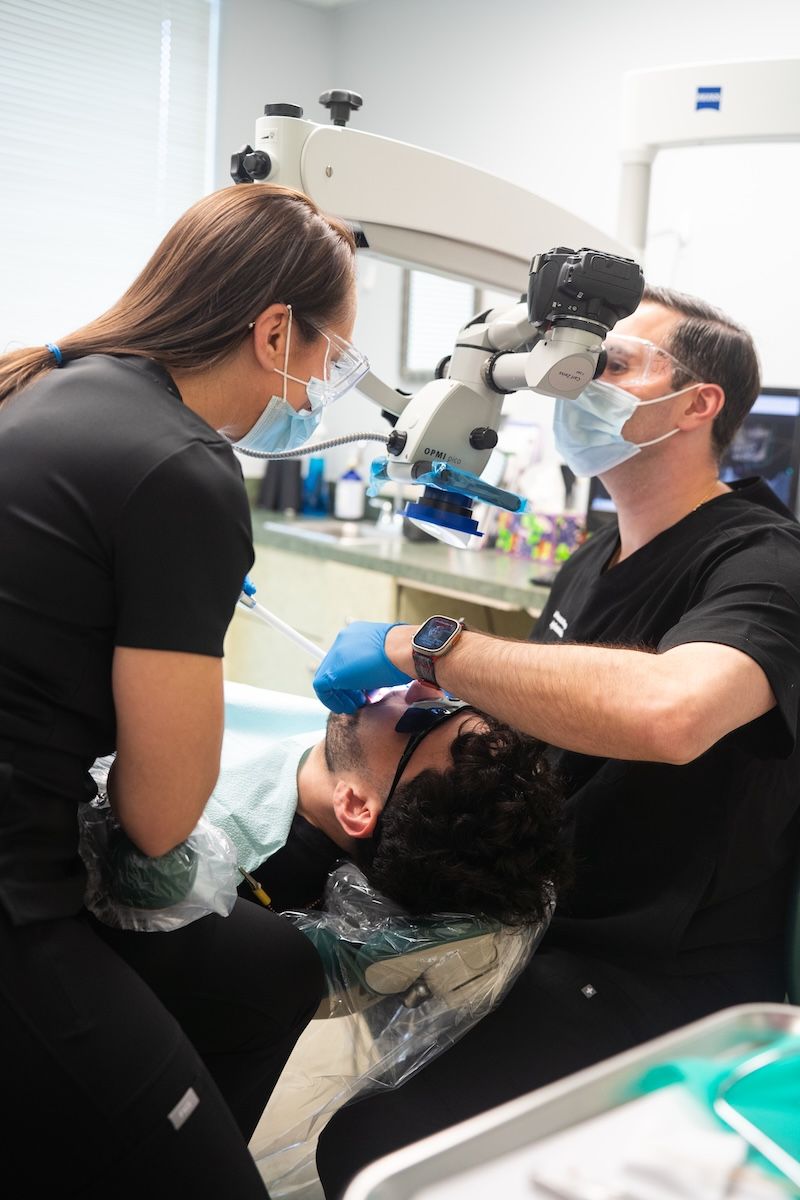
An apicoectomy is a minor surgical procedure that removes infection from the tip of a tooth root when a root canal alone has not resolved the problem. At Ivy Endodontics in Plainsboro, NJ, Dr. Franco DeMayo and Dr. Jean Kang perform apicoectomies using magnification and precise surgical technique to save teeth that would otherwise need to be extracted. Most patients are referred to us by their general dentist, and most are back to normal activity within a day or two.
What Is an Apicoectomy?
An apicoectomy, also called root-end surgery or root-end resection, is a minor surgical procedure that targets the tip or apex of a tooth's root. During the procedure, your endodontist makes a small incision in the gum tissue near the affected tooth, gently moves the tissue aside to access the underlying bone, removes the infected tissue along with the very tip of the root, and seals the end of the root canal with a biocompatible filling material.
The procedure typically takes between 30 and 90 minutes depending on the location and complexity of the tooth involved. Most patients return to normal activities within a day or two.
When Is an Apicoectomy Needed?
An apicoectomy is typically recommended when a tooth has already had root canal therapy but continues to cause symptoms or shows signs of ongoing infection on X-rays. In some cases, the complex anatomy of a root canal tiny branches, calcified canals, or a fracture near the root tip makes it impossible to fully resolve the problem through the crown of the tooth alone.
You may be a candidate for an apicoectomy if you are experiencing any of the following:
Persistent pain or swelling in a previously root canal-treated tooth
- A cyst or abscess that has formed at the root tip
- A previously treated tooth that has not healed as expected
- Infection that has spread to surrounding bone tissue
- A root fracture or crack near the tip that cannot be accessed from above
- A failed or incomplete initial root canal that cannot be retreated through the crown
- A post or crown that cannot be easily removed to allow for conventional retreatment
If you are unsure whether your symptoms are related to a tooth that has already been treated, we encourage you to call our office. We are happy to evaluate your situation and walk you through your options.
What to Expect During the Procedure
Before the procedure begins, we will administer a local anesthetic to ensure you are completely comfortable throughout. You should not feel pain during the procedure only occasional pressure or light vibration.
Once the area is numb, your endodontist will make a small incision in the gum tissue to expose the bone and the tip of the root. Using a surgical microscope and specialized micro-instruments, we remove the last few millimeters of the root along with any infected tissue. The root end is then cleaned, shaped, and sealed with a small filling material typically a bio-ceramic putty for the root end filling that prevents bacteria from re-entering the root.
At our practice, we also generally place a bone graft or foundation in the osteotomy site and then a resorbable membrane to optimize healing and preserve bone structure.
The gum tissue is then carefully sutured closed. Healing typically progresses well, and sutures are usually removed within one week. Bone regeneration at the surgical site occurs naturally over the following weeks and months and can be confirmed with follow-up imaging.
Why Choose an Endodontist for Your Apicoectomy?
Endodontists are dental specialists who focus exclusively on diagnosing and treating conditions involving the interior of the tooth and surrounding root structures. After completing dental school, endodontists complete two to three additional years of advanced surgical training including extensive experience with root-end procedures.
At Ivy Endodontics at Princeton, our team performs apicoectomies using high-powered surgical microscopes, which allow us to see the root tip and surrounding tissue with extraordinary precision. We also use cone-beam computed tomography (CBCT) imaging to create a detailed three-dimensional view of the tooth's anatomy before your procedure, so there are no surprises once we begin.
Ivy Endodontics serves patients throughout Central Jersey, including Mercer and Middlesex County communities. We accept direct referrals from general dentists as well as patients who reach out to us on their own.
Ready to Find Out If an Apicoectomy Is Right for You?
Our team at Ivy Endodontics at Princeton is here to answer every question and walk you through exactly what to expect. We offer thorough consultations in a calm, unhurried environment so you can make the decision that is right for you.